
Getting a new puppy is supposed to mean excitement, fun and probably a few sleepless nights. What you don’t necessarily expect is to suddenly find yourself looking at a seriously damaged carpet that runs throughout your property.
Unfortunately, that’s exactly what happened to one of our recent customers.
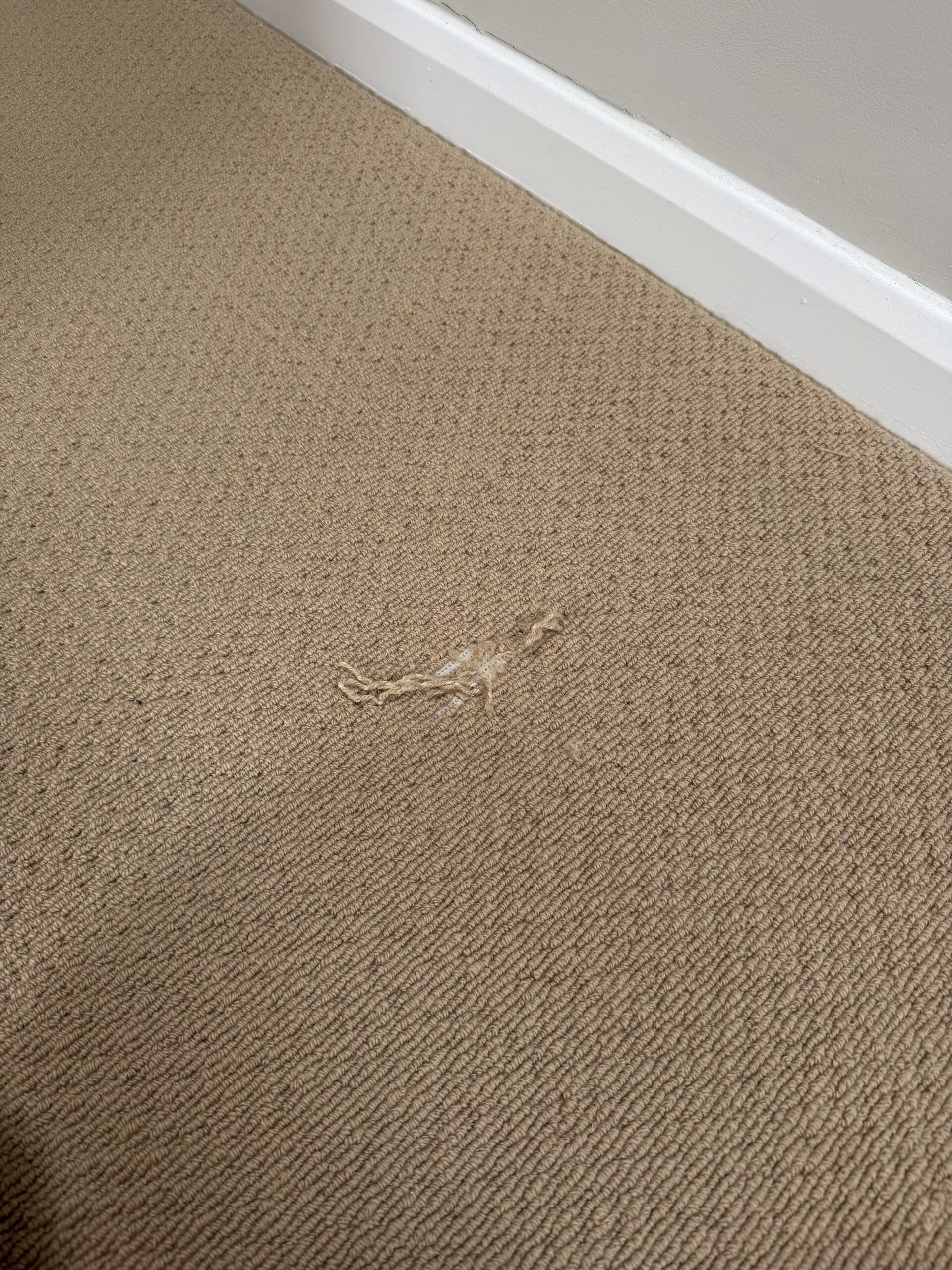
Their new Jack Russell puppy had managed to get hold of the loop pile carpet and pull it, causing a significant area of damage. And this wasn’t an old carpet that was due for replacement anyway. It was a carpet running continuously through the property, which meant the thought of having to replace it because of one area of puppy damage was an absolute nightmare.
By the time we were contacted, what started as a mischievous puppy moment had become a potentially very expensive problem.
Fortunately, before going down the replacement route, they called The Carpet Repair Guys.
Why Puppy Damage Can Be So Bad on a Loop Pile Carpet
We repair an enormous amount of pet-damaged carpet, but loop pile carpets present a very particular challenge.
With many carpets, damage can sometimes be isolated relatively cleanly and a donor section inserted into the affected area. With a loop pile construction, things aren’t always so straightforward.
The surface is created from loops of yarn, and once those loops are pulled, snagged or unravelled, the damage can spread along the carpet construction. A puppy only needs to find one loose or accessible piece and start pulling.
And if you’ve ever owned a Jack Russell, you’ll probably know that once they’ve decided they’re interested in something, they can be remarkably determined!
What might initially look like a relatively small pull can therefore turn into something much more substantial.
That is why we always advise people with loop pile carpets to be particularly careful with snags. Don’t pull them, don’t keep cutting at them and don’t assume that because the damaged section looks loose it can simply be removed.
You can very quickly make the situation considerably worse.
This Is Not an Easy Carpet to Repair
We think it’s important to be completely open about this.
Loop pile carpet is one of the more difficult types of carpet to repair well.
When you’re dealing with significant pulled-loop damage, you’re trying to recreate an appearance that was originally manufactured as part of a continuous carpet construction. You’re doing that by hand, on an existing carpet, which may already have differences in tension, wear, pile direction and appearance.
That’s why we would never tell a customer that this sort of repair is guaranteed to become completely invisible.
It isn’t realistic.
There is a big difference between saying something can be repaired and promising somebody they will never be able to find the repaired area again.
Our job is to take something that’s currently an eyesore and use our experience and specialist techniques to make it blend back into the surrounding carpet as successfully as the carpet allows.
And sometimes that distinction gets lost when people talk about carpet repairs.
Will a Loop Pile Carpet Repair Be 100% Perfect?
Probably not.
And we’d much rather tell you that before we start than promise you something that isn’t achievable.
Our aim with a difficult loop pile repair is to get the damaged area to a point where it no longer immediately catches your eye. We want someone walking into the room to see the room and the carpet, rather than their attention being drawn straight towards the damage.
Could we stand over the repair afterwards, point directly at it and find tiny imperfections?
Absolutely.
But perhaps our idea of perfection is slightly different from most people’s.
When you spend your working life repairing carpets, you naturally look at them differently. We’ll notice a fibre sitting slightly differently. We’ll notice a tiny variation in the direction of the pile. We’ll see something from a particular angle that most people would probably walk past every day without giving it a second thought.
That’s the standard we judge ourselves against.
So when we say a repair isn’t 100% perfect, that doesn’t mean it isn’t a very successful repair.
Sometimes it simply means we know where we’ve been working.
From an Absolute Eyesore to a Carpet You Can Live With Again
That’s really the point of a repair like this.
Before we arrived, the puppy damage dominated the area. You couldn’t help but notice it.
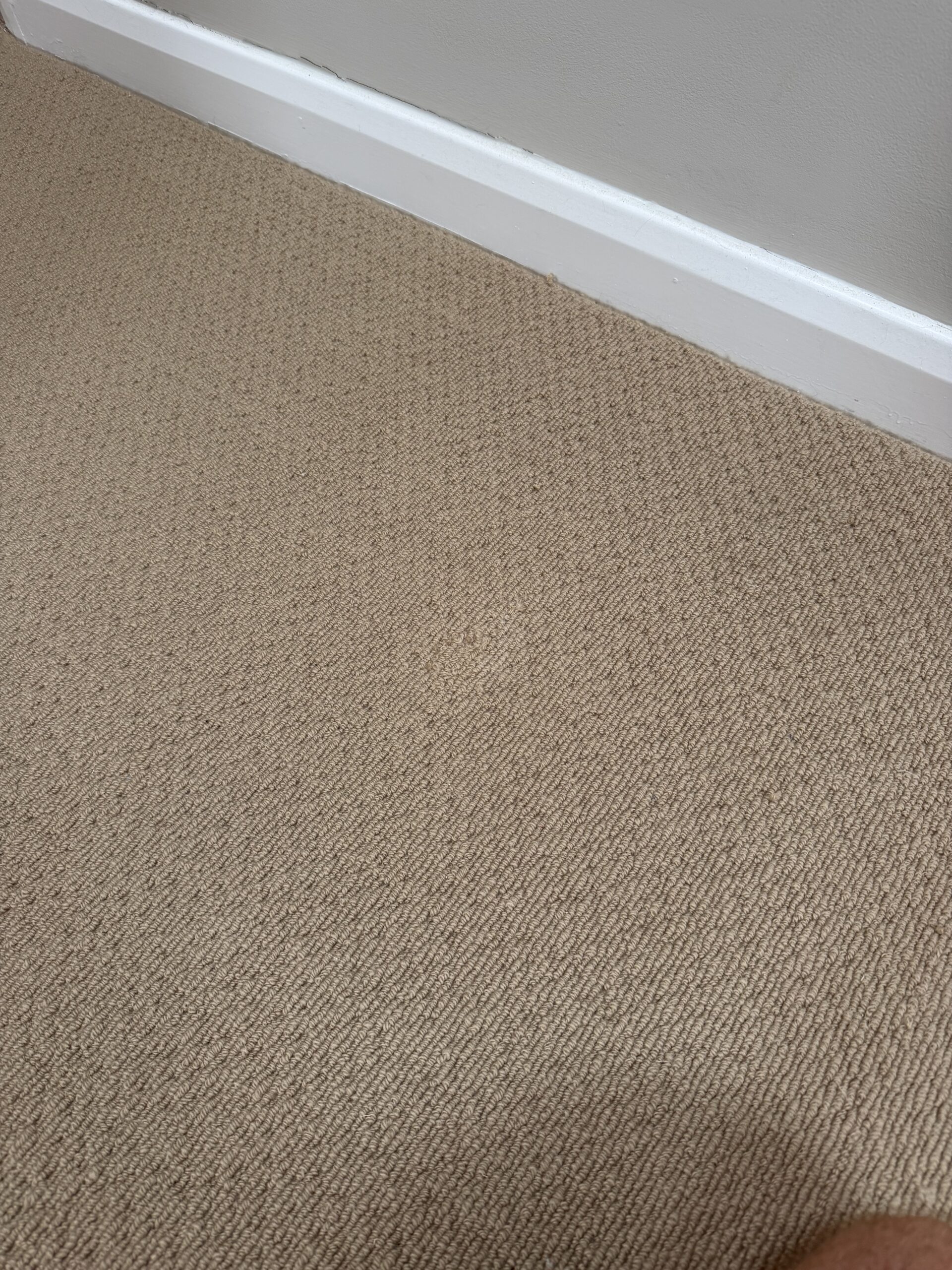
After careful repair work, the carpet could once again do what a carpet is supposed to do — sit in the background as part of the room rather than being the first thing everybody notices.
And when you consider the alternative, that’s hugely important.
Because this carpet ran through the property, replacing the affected area wasn’t necessarily as simple as buying a small piece of carpet for one room. Continuous carpets can create a much bigger replacement problem, particularly if an exact match is unavailable.
Suddenly, one Jack Russell having a little too much fun can potentially lead to a very substantial replacement bill.
That is why we always recommend investigating whether a professional repair is possible first.
Pet-Damaged Carpet Doesn’t Automatically Mean Replacement
We regularly receive photographs from customers who are convinced their carpet is beyond saving.
Sometimes they’ve already spoken to a carpet fitter or retailer and have been told that replacement is the only realistic option.
And occasionally, replacement genuinely is the correct answer. We don’t believe in repairing something simply for the sake of saying we’ve repaired it.
But carpet repair is a specialist trade in its own right.
There are techniques available to an experienced carpet repair specialist that aren’t necessarily part of normal carpet fitting. That’s particularly important with unusual damage, because the solution isn’t always obvious.
We work on pet-damaged carpets, iron burns, holes, moth damage, damaged stairs, doorway damage, pulled carpets, loose carpets and many other forms of accidental damage, and every job starts with the same question:
What is the best and least intrusive way of improving this carpet?
Sometimes that’s a traditional patch. Sometimes it’s rebuilding an area. Sometimes it’s working with individual fibres or loops. And sometimes it’s a combination of techniques.
Experience tells you which direction to take.
Nearly 30 Years of Working With Carpets
We’ve been working with carpets since 1997, and there’s something we’ve learned repeatedly over those years: carpets don’t always behave the way you expect them to.
Two carpets that look almost identical can react completely differently when you start working with them.
Construction matters. Age matters. Wear matters. The availability and condition of donor material matters. Even the direction from which natural light enters a room can affect how a repaired area appears afterwards.
That’s particularly true with loop pile carpet repairs.
This is why photographs are so useful when customers first contact us. They allow us to look at the carpet construction, the type of damage and the surrounding area before deciding whether a repair is realistically worth attempting.
We would rather tell somebody beforehand that a repair is likely to remain slightly visible than arrive promising an invisible result that the carpet simply cannot deliver.
Sometimes a Successful Repair Isn’t an Invisible Repair
This is probably one of the biggest misconceptions surrounding professional carpet repair.
Customers naturally want perfection. We understand that.
So do we.
But sometimes the measure of a successful repair isn’t whether you can inspect the carpet from six inches away and find absolutely no evidence that anybody has worked on it.
The better question can be:
Does the damage still bother you?
If you’ve gone from walking into a room and immediately seeing a large pulled section of carpet to having to deliberately look for the repaired area, that’s a very different carpet.
That’s what we’re trying to achieve on difficult repairs.
We’ll always push for the best result the carpet will give us. We’re probably our own harshest critics, and we’ll often continue tweaking something that the customer already thinks looks fantastic.
Maybe our version of perfection is higher than most people’s.
But we’d rather be that way.
Has Your Puppy or Dog Damaged Your Carpet?
If your dog, puppy or other pet has pulled, scratched, chewed or damaged your carpet, don’t assume the whole carpet needs replacing.
And particularly with a loop pile carpet, try not to start pulling at loose fibres yourself. What looks like one loose strand can potentially be connected to considerably more of the carpet than you realise.
Take a few clear photographs showing both the damage close up and the surrounding carpet and send them to The Carpet Repair Guys.
We carry out specialist pet-damaged carpet repairs and loop pile carpet repairs across London, Kent, Essex and Surrey, and we’ll give you an honest opinion about what can realistically be achieved.
We won’t promise miracles.
We won’t tell you every repair will disappear completely.
What we will do is use nearly three decades of carpet experience to get the best result we believe your carpet is capable of.
And if your new Jack Russell has just turned your beautiful loop pile carpet into what looks like an absolute disaster, don’t panic just yet.
It might not be the disaster you think it is.
Carpet repair Kent | Carpet repair London | Professional carpet restoration | Christmas carpet repair | The Carpet Repair Guys
s save your carpet – why replace when we can repair!


